
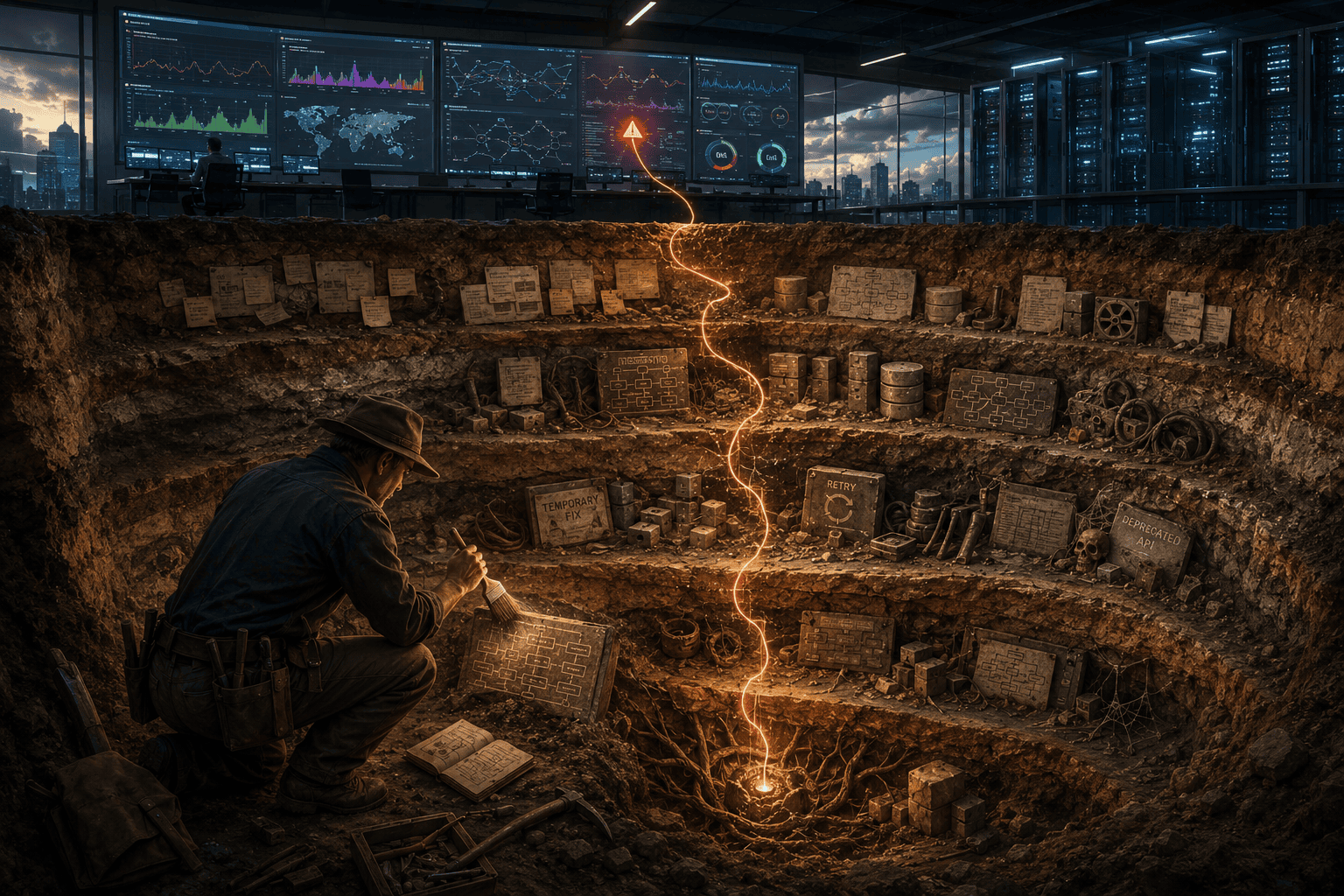
Temporal Architectural Reviews (TAR) Ask What Complexity Does to Systems Over Time
Modern software systems are astonishingly observable.
We can trace requests across continents, measure latency down to milliseconds, reconstruct dependency chains in real time, and watch distributed systems react to changing conditions almost instantaneously. Platforms like Datadog Developer, Honeycomb Software, Grafana Labs, Dynatrace, New Relic, Elastic, and OpenTelemetry fundamentally changed operations culture by giving engineers visibility into systems that had become too large, too dynamic, and too interconnected for traditional monitoring approaches.
The observability movement taught the industry something important: complex systems cannot always be predicted in advance. They must be explored.
That was a profound shift.
Traditional monitoring largely revolved around thresholds and alarms. CPU exceeded a percentage. Disk usage crossed a line. A server stopped responding. Observability introduced a different mindset. Instead of simply asking whether something was broken, engineers began asking whether they could understand why the system behaved the way it did. Distributed tracing, dynamic telemetry, dependency mapping, and causal analysis transformed production systems from opaque machinery into something closer to a navigable landscape.
But observability primarily tells us what the system is doing now.
Temporal Architectural Reviews ask a different question:
What has complexity been doing to the system over time?
That distinction matters more than many organizations realize.
Most catastrophic failures are not truly sudden failures. They are accumulated failures. Complexity rarely arrives all at once. It accumulates quietly, often invisibly, through years of small decisions that individually appear reasonable. A temporary workaround survives longer than expected. A retry policy is copied into another service. A database query that once seemed trivial remains unchanged as scale grows around it. Another abstraction layer is added because it solves an immediate problem. Another dependency enters the environment because integrating it was faster than redesigning the workflow.
None of these decisions are necessarily wrong in isolation.
But systems do not experience decisions in isolation. Systems experience interactions over time.
This is where Temporal Architectural Reviews begin to diverge from traditional operational thinking. Observability is exceptionally good at exposing runtime symptoms: latency spikes, queue buildup, connection exhaustion, cascading retries, saturation, resource contention, noisy neighbors, and anomalous behavior. But TAR is interested in the slow-moving architectural transformations that create the conditions where those symptoms eventually emerge.
Years ago, I encountered a system with what appeared to be a harmless health check. Periodically, the application executed a database query to verify responsiveness and connectivity. At the time the query was introduced, the table it targeted was relatively small, and the operation completed quickly enough that nobody thought much about it.
SELECT COUNT(*) FROM table
The system worked. Dashboards stayed green. Nobody had any reason to suspect the query would eventually become problematic.
But time passed.
The business grew. The dataset expanded. What had once been a small table became a very large one. The health check began taking longer. Infrastructure scaled to compensate. Thread pools became busier. Database contention increased. Connection pools experienced pressure. Eventually the application began exhibiting intermittent latency and operational instability.
At that point, observability tooling became extremely valuable. Dashboards surfaced elevated response times. Tracing revealed downstream pressure. Database utilization climbed. Operators could finally see the symptoms clearly.
But TAR asks a different question.
Why did the architecture evolve into a state where a health check became operationally dangerous?
The problem was never simply the query itself. The real issue was temporal architectural drift. Somewhere in the past, an assumption had quietly become embedded into the system:
“This table will always remain small enough that this operation is trivial.”
That assumption survived long after the surrounding environment changed. Nobody revisited it because nothing visibly broke at first. The architecture continued carrying yesterday’s assumptions into today’s scale.
This is one of the most dangerous properties of temporal complexity: systems often preserve old truths long after they stop being true.
Observability reveals pressure. TAR examines the sediment layers beneath it.
The count(*) story was not merely a performance issue. It was evidence of a system whose operational environment had evolved faster than its architectural assumptions. It exposed missing review loops, invisible coupling between growth and design, and an organization that lacked mechanisms for continuously reevaluating architectural decisions as scale changed over time.
In many organizations, architecture is treated as a relatively static discipline. Teams perform architecture reviews before implementation, validate scalability assumptions, discuss patterns, security concerns, and infrastructure requirements, and then move on. But systems are not static artifacts. They are living accumulations of decisions interacting with time, incentives, scale, staffing changes, business priorities, operational habits, and environmental conditions.
Complexity is not merely something systems contain.
Complexity is something systems accumulate.
This is one reason the observability movement has gradually begun drifting toward more architectural thinking. Modern observability platforms increasingly reconstruct service topology, dependency relationships, deployment history, propagation paths, and operational timelines because the industry is slowly recognizing that runtime behavior cannot be separated from architectural evolution. You cannot fully understand production systems without understanding how they became the systems they are.
This becomes even more important when sustainability enters the discussion.
Architectural inefficiency is never purely abstract. Complexity has physical consequences. Inefficient systems consume additional compute resources, waste energy, inflate cloud costs, increase cooling requirements, and narrow resilience margins. Operational fragility eventually manifests as environmental and economic fragility as well.
This is why performance, cost, and carbon are often manifestations of the same underlying architectural conditions. They are different expressions of how efficiently a system transforms resources into outcomes over time.
Observability measures the metabolism.
Temporal Architectural Reviews study the long-term health of the organism.
And increasingly, organizations need both.
Because the future of software architecture will not belong solely to organizations that can detect incidents quickly. It will belong to organizations capable of recognizing how complexity evolves before those incidents become inevitable.
No responses yet