
An ESI Story About Systems We Thought We Understood
There’s a story I keep coming back to.
Depending on who tells it, it’s a story about a transmission line, a utility failure, infrastructure planning, resilience engineering, climate risk, or operations. But underneath all of those interpretations is something deeper. It’s really a story about systems — and about what happens when systems become so large, interconnected, and complex that nobody can fully see the whole picture anymore.
The Story
One day, a goose landed in the wrong place.
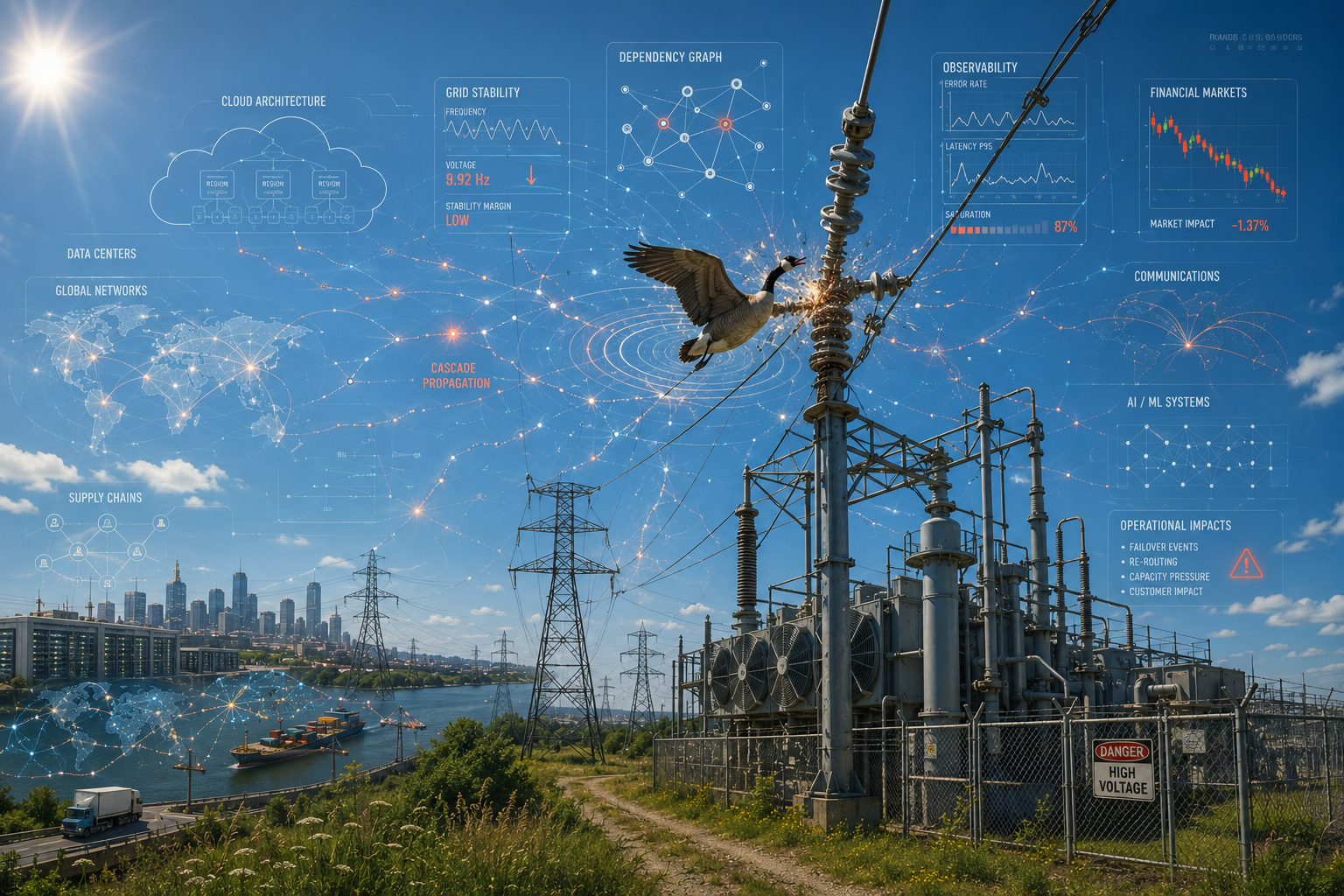
That sounds absurdly small, and in some ways it was. A bird. A moment. A tiny interaction with a piece of infrastructure most people never think about. But the goose contacted a high-voltage line. The line faulted. Protection systems activated. Power shifted. Other systems absorbed the load, and some of those systems were already fragile. Others had been configured around assumptions nobody had revisited in years.
Redundancies existed — at least on paper.
But failover procedures had not been fully exercised. Dependencies were poorly understood. Operational knowledge was fragmented across teams. Infrastructure ownership was distributed across organizations and silos. Many of the people closest to individual components could not see how their local decisions affected the larger system.
What followed was not really “a goose outage.”
It was a systems failure.
The goose was merely the catalyst.
The Problem With Modern Systems

Modern infrastructure increasingly behaves less like a machine and more like an ecosystem. Cloud environments, supply chains, power grids, data centers, AI systems, telecommunications networks, financial markets, and software delivery pipelines are all deeply interconnected, tightly coupled, globally distributed, economically optimized, and increasingly opaque.
That means small disturbances can propagate in ways nobody anticipates.
Not because people are incompetent. Not because engineers are careless. But because complexity eventually exceeds the limits of local visibility. Everybody sees their piece. Very few people see the system.
This is Where Engineering Systems Intelligence (ESI) Begins
ESI starts from a deceptively simple observation:
Systems create behaviors that individual components cannot explain on their own.
A database query may look harmless in isolation. A retry policy may seem reasonable. An autoscaler may appear efficient. A caching layer may reduce latency. A cloud region may appear redundant.
But once these components interact over time — under load, across organizational boundaries, within economic incentives, environmental constraints, and human assumptions — entirely new behaviors emerge.
That’s the system.
And most organizations are still trying to manage these environments using fragmented tooling and siloed perspectives. Observability sees telemetry. FinOps sees cost. Security sees threats. Sustainability sees carbon. Reliability engineering sees uptime.
ESI asks a broader question:
What if all of these are manifestations of the same underlying system dynamics?
One of the most dangerous habits in technology is our obsession with proximate causes. We love singular explanations because they make the world feel controllable.
“The outage was caused by a goose.” “The incident was caused by a bad deploy.” “The slowdown was caused by the database.” “The breach was caused by human error.”
But complex systems rarely fail because of a single thing.

They fail because assumptions accumulate, visibility erodes, incentives drift, dependencies multiply, optimization narrows margins, and resilience quietly degrades over time. The triggering event is often the least interesting part. The real story is why the system could no longer absorb disturbance.
This is also one of the places where ESI intersects directly with sustainable IT, because the same forces that create fragility often create waste.
Overprovisioning. Retry storms. Excessive coupling. Unused infrastructure. Redundant data movement. Inefficient software. Poor architectural boundaries. Hidden dependencies.
Organizations often treat these as separate concerns — performance problems, cloud cost problems, sustainability problems, resilience problems, governance problems — but they are frequently symptoms of the same underlying system behavior.
Waste is not just an environmental issue. Waste is often a signal that the system itself is poorly understood. And systems we do not understand are difficult to govern safely.
One of the recurring patterns in large systems is that teams optimize locally while degrading the global system. Each individual decision may appear rational. One team adds retries to improve reliability. Another adds buffering. Another adds caching, replication, abstraction layers, or AI orchestration.
Individually, each improvement makes sense.
Collectively, the system becomes harder to reason about. Latency increases. Resource consumption grows. Failure modes multiply. Operational understanding fragments.
This is one of the central tensions ESI attempts to surface: local optimization can produce global fragility.
The Goose Was Never the Root Cause
The goose merely revealed what was already there.
One of the hardest parts of modern infrastructure is that people normalize the systems around them. Engineers stop seeing the assumptions. Organizations stop seeing the waste. Leadership stops seeing the dependencies.
Eventually, the system becomes invisible precisely because it is familiar.
Until something strange happens.
A goose. A heat wave. A drought. A supply chain interruption. A regional cloud outage. A runaway AI workload.
Suddenly everyone remembers that the digital world is still physical. Data centers require electricity. Cooling systems require water. Cloud regions sit inside climates. Networks rely on physical infrastructure. Software consumes material resources.
Part of ESI is about developing borrowed eyes — the ability to see hidden coupling, invisible dependencies, deferred risk, systemic waste, organizational blind spots, and emergent behavior before the goose lands.
The Future of Engineering
The engineering disciplines of the industrial age evolved around increasingly complex physical systems: civil engineering, mechanical engineering, electrical engineering, and systems engineering.

But software systems have now reached a scale where they influence economies, ecosystems, geopolitics, energy grids, labor markets, public discourse, and environmental systems.
Yet many organizations still treat software primarily as feature delivery.
ESI argues that we need a broader discipline — one capable of understanding how technical systems interact with physical infrastructure, environmental constraints, organizational incentives, human cognition, governance, and time.
Not because engineers need to control everything.
But because systems we cannot see clearly eventually surprise us.
And increasingly, those surprises scale globally.
The goose story is memorable because it feels ridiculous. People laugh when they first hear it.
“A goose caused an outage? Really?”
But that framing misses the point entirely.
The goose did not create fragility. It revealed fragility.
That distinction matters, because in complex systems the triggering event is often accidental, but the conditions that allow small disturbances to cascade are usually designed — sometimes intentionally, sometimes economically, sometimes organizationally, and sometimes simply through years of accumulated complexity.
The real challenge is not preventing every goose.
The real challenge is building systems that remain understandable, adaptable, resilient, and governable even when unexpected things happen.
That is the work.
And increasingly, that is what Engineering Systems Intelligence is trying to help us see.
No responses yet